Organic Egg Production

July 23rd, 2015

Back in the day when my parents shopped for eggs they only had one or maybe two options!


Today’s blog has been written by Ryan Melowic Senior Director of Procurement Process Improvement at SafeSourcing.

According to Wikipedia, “Organic egg production is the production of eggs through organic means. In this process, the poultry are fed organic feed. According to the United States Department of Agriculture, organic means that the laying hens must have access to the outdoors and cannot be raised in cages. [1] Organic egg producers cannot use antibiotics except during an infectious outbreak. Only natural molting can occur within the flock; forced molting is not allowed. Organic certification also requires maintenance of basic animal welfare standards.”

Organic Eggs are one of the many options for eggs on the market today. Back in the day when my parents shopped for eggs they only had one or maybe two options: white or brown eggs. Now there are multiple choices such as enriched with omega 3, cage-free and fertile eggs. Each egg type has a different price point. In addition, when you add the effect that the Bird Flu outbreaks had on America’s chicken flock, prices have sky rocketed.

SafeSourcing does the due diligence to ensure its supplier database is packed full of quality suppliers.  Organic Egg Production is an example of one of the many requirements that SafeSourcing tracks.  For more information on how SafeSourcing can help you with insuring certified suppliers, please contact a SafeSourcing Customer Service representative.

We look forward to and appreciate your comments.
Water World

July 22nd, 2015

Tired of wasting water?


Today’s post is by Troy Lowe; Vice President of Development at SafeSourcing.

If your kitchen sink is like many others, it takes a while to get your water up to the correct temperature.  Running the water and waiting can waste gallons of water.  The reason for this delay is usually the distance between the kitchen and the location of the water heater.  When you turn on the water, the water in the pipes needs to be emptied so that the hot water can be released.  Because of this, there are products that you can purchase that can be installed under the sink and plugged into a standard outlet.  These tankless water heaters heat the water as you are using it so there is no waiting for the hot water, which results in savings for you.  Most of the units come with two connections; one for the hot water to the sink and the other for a connection to the dishwasher.  Using the temperature dial, you can set the water to the desired temperature.  Installing one of these systems will help you save time, water and money.

There are many units to choose from so if you need help researching contact SafeSourcing for help.  At SafeSourcing, we can gather all the necessary information for you and help you decide which product meets your needs.  If you would like more information on how SafeSourcing can help you, please contact a SafeSourcing Customer Service representative. We have an entire team ready to assist you today.

We look forward to your comments.

Is Buying Name Brand Always the Best Choice?

July 16th, 2015

Five examples of name-brand products versus generic that might prove generic to be a good choice.


Today’s post is by Gayl M. Southard, Administrative Consultant for SafeSourcing.

Whether single, married, large or small family, trying to save money is a good feeling.  It may be tempting to buy generic to save money, but it is not always the right choice.

Here are five examples of name-brand products versus generic that might prove generic to be a good choice.

1.  Cereal is one example of trying to save money.  For every name-brand cereal, there generally is a generic version.  Often time the generic brand will also have a similar name.  The Kellogg’s Corn Flakes brand cereal will cost roughly $2.98, while an 18-ounce generic brand will cost $1.98.  That’s a big savings.  There is not too much difference in taste.

2.  Spices and seasonings are another way to save some money.  A name brand bottle of basil costs $2.96 while a generic alternative costs $2.24.  That 72 cent savings can add up!

3.  Parents want the best for their babies.  Maybe spending extra on the brand-named baby food and other baby products may be worth it.  Diapers can prove to be a big savings.   Buying generic versus a name brand you can save 10 cents per diaper.

4.  Medication is also an example where savings can be realized.  Take aspirin and ibuprofen as an example.  At a drug store 100 (200 mg) tablets cost $9.99 versus a store brand of 100 tablets for $7.29.

5.  Gasoline is another example.  Commuting to work can be very costly.  It can also be an area where buying generic might be a good choice for you.  Filling up at a major gasoline company versus the Costco brand can yield significant savings.  In California where you might pay $4.79/gallon for regular gas, the Costco brand is approximately $2.85/gallon.  For 15 gallons of gas, you could save approximately $29 each time you have to fill your tank.  That’s a huge savings!

It’s all personal preference on how you choose to spend your dollars.  SafeSourcing can assist you in exploring your procurement solutions for your business or on our “Risk Free” trial program, please contact a SafeSourcing Customer Service Representative. We have an entire customer services team waiting to assist you today.

We look forward to your comments.

Cotton and the Commodity Market: How to Deal with Market Volatility

July 15th, 2015

How can companies protect themselves from commodity and market volatility??


Todays post is a timely repost from our SafeSourcing archive.

Variable costs can reap havoc on any company budget, they are more difficult to forecast and prepare for than fixed costs.? Throw in large increases followed by unexpected decreases in any given year, and forecasting becomes almost impossible.? As commodity prices continue to fill the market with extreme volatility?cotton being the current culprit?manufacturers, suppliers and procurement professionals are struggling to remain competitive.

Is there any relief in sight for the drastic shifts in commodity prices?? Cotton, after having a record high price early in the year, now is experiencing a strong drop in price, nearly a fifty percent decrease from the spring.? After already imposing a price increase, manufacturers and suppliers are faced with decisions on how to most effectively reflect the price shifts?again.

How can you protect yourself from the risk in the commodity market?? Planning is a crucial step.? With the uncertainty in not only the commodity market, but the financial market as well, the best defense is to develop a strategic plan for potential macroeconomic risks that could affect your company.

Possessing a detailed forecast of the global economy in any given time horizon will not only keep you relevant, it will allow you to have steps in place to overcome any potential unforeseen events.? Along with a strategic plan, implementing escalator and de-escalator language into contracts for those products most affected by commodity risk will ensure that you are more protected from drastic market shifts.? Unexplained market volatility and unforeseen events have the potential to seriously damage and sometimes destroy a company; take the steps today to implement a strategic plan to shield your company from market uncertainty.

For more information on SafeSourcing and how we can assist with this process, please contact a SafeSourcing Customer Services Project Manager for more information.

We look forward to and appreciate your comments.

Procurement Professionals – The Next Generation

July 10th, 2015

With the world of data and procurement changing every day, what are you looking for in the next generation of procurement professionals?


Today’s post is from our  SafeSourcing archive.

As competition for qualified procurement talent begins to increase with the departure of a strong Baby Boomer generation and the lack of an equivalent group of strong resources, managers must begin to rethink the talent they are searching for and explore new methods for getting the best associates possible.  Luckily there is an increase of institutions offering procurement and supply chain specific degrees and students that are actively pursuing these paths.  Today we will look at some of these new areas to focus on when beginning your searches for new employees.

Work with the Schools – A few weeks ago we posted a blog about the rising increase in universities who are bolstering their offering for degrees in Supply Chain Management and Procurement and in the rise in students seeking these degrees.  By working with the universities directly, you can ensure that your company is able to get the first pick at the best and the brightest.  As the stronger students in traditional areas like Law, Medicine and Engineering begin to move towards new untapped areas of business, this group of potential employees will get stronger and stronger.  Many times there are even groups of several universities that share common resources and hiring sites for all of their students to search.

Data Analysis Skills – We no longer live in a world that is going to continue to source based on face to face meetings and paper bids alone.  Whether or not you work with a 3rd party Strategic Sourcing company like SafeSourcing, the need to analyze and understand data is going to become critical as we move forward.  Pivot tables, excel skills and even some SQL knowledge will not just be nice-to-have skillsets they will be requirements.  Understanding where your potential candidates are in this area will help you to gauge how effective they can be for your team.  As with any sourcing project, the foundation of data you start with and provide vendors will set the stage for the success of the project and having data analytics skills are crucial to creating that foundation.

Deep VS Broad – This is one of the struggles of any procurement manager trying to hire for their team.  The case can be made for both sides.  On the one hand having an employee who has broad knowledge across several categories allows them to take on more projects and be effective immediately.  This type of experience is good when the team they are going to is smaller and needs a diverse experience.  Candidates with deep knowledge in a few of the more difficult areas such as construction, services or IT are also very important because the stakeholders in your company want to work with people who know what they are doing.  Larger procurement teams have the luxury of hiring more specialized candidates but in reality the ideal candidate will be a mix; someone who has a specialty area or two, but also has a broad level of experience in other areas.  Understanding the specific projects someone has worked on will be an important evaluation piece through the hiring process.

The team you build for your procurement department is changing as quickly as the landscape of procurement and new elements need to be focused on.  Skills in data analysis and broad category experience with a focus on a few complex areas are now key for delivering projects successfully and efficiently.  For more information about SafeSourcing can help fill in some of the experience categories or can assist you with spend analysis, or on our “Risk Free” trial program, please contact a SafeSourcing Project Manager.  We have an entire customer services team waiting to assist you today.

We look forward to your comments.

Procuring Services for Your Organization

July 7th, 2015

What are some thoughts to keep in mind when procuring any type of services for your organization?"


Todays post is from our SafeSourcing Archive

The process of procuring services for you organization has a few aspects to keep in mind that are different then processes involving typically procured products.  How the company currently purchases these services tends to be varied and additional expenses that tend to be “bundled” into the price frequently provide very little visibility for you to understand what you are paying for.

The following are just a few tips to keep in mind when you are preparing the initial stages of finding new service providers.

Understand how and from whom you work with today – So many companies, especially those with more than one location, have an unclear view of the relationships, contracts, and pricing that they pay for the exact same services throughout the organization.  Understanding how each part of the company works with the providers of the services you are looking for is a critical first step to successfully developing a strategy for the entire organization.

Develop the strategy of where you want to go – Once you know where things stand it won’t be uncommon to have a variety of different contracts, terms and companies that you are dealing with.  Instead of trying to fit what you want into everyone’s model or contract, this is the time for you to determine how you want to be billed.  Knowing this and providing it to the vendor community early will help you get the details you need to make the best decision for the company.

Define Additional Expenses – Almost every vendor has a price list of “additional services” that fall outside of the normal course of business.  It is very important that you require every vendor you speak with to provide you the complete list of these fees and that they understand that any fee not listed will not be honored as part of the new contract with you.

Unbundle the “upcharge” – Upcharges are one of the great mysteries in dealing with service provider companies; many of whom would prefer to give you invoices with nothing more than one line item showing the weekly, monthly or annual charge.  By requesting the vendors to break this charge into smaller more detailed components, it will be easier for you to determine what you are paying for and will also give you stronger footing from which to negotiate your relationship with them.

For more information on best practices in procuring services for your company, please contact a SafeSourcing Customer Services Project Manager.

We look forward to your comments.

You can’t own the sun

July 2nd, 2015

hy understanding ownership is important


Today’s post is by Michael Figueroa, Project Manager at SafeSourcing

Maria Duran, of Spain, has been selling “plots” of the sun on eBay since 20131 . She created documents laying claim to our solar system’s only star and had them notarized, and auctioned off these plots with notarized certificates. When Ebay shut down her online store, she sued (Can anyone who’s ever been sunburnt sue her?) However crazy her claims may sound, how is it any different than from any other ownership claim? How does a person or organization make claim to land, goods, oceans, or ideas, and prove or disprove “ownership” other than to say “that’s mine!”? There are two basic concepts at the heart of every ownership claim:

Ownership as an agreed-upon standard within a society:
In most civilized societies, ownership standards are established that “legitimize” a claim. These claims are only functional because of the compliance of the society as a whole with this standard. This is very similar in concept to money: It’s only as good as what people agree to trade you for it. There are places in the world where claims to ownership of even human beings are commonly made. This is why having agreed upon standards within that society are so important; Allowing ownership of people, life or shared life-giving resources (like water or the sun) can have (and have had) disastrous outcomes for societies.

Ownership as control that cannot be overcome:
The other standard of ownership stems from simply exerting control over an object that no-one else has the power to oppose. Ownership claims of territory by governments are in place all over the world, enforced by the threat of exerting control through the military. Ideally force is used only to protect the more peaceful standard of agreed-upon societal ownership standards.

There are costs and benefits associated with ownership. In purchasing, WHEN transfer of ownership takes place is critically important. Concerns arising from point-of-ownership include:

·  Who pays for freight?
·  Who pays for damaged goods?
·  Who is responsible for temperature control?
·  What happens if product is not up to spec?
·  How do I verify transfer of ownership happened?

[1] “The curious case of the woman suing eBay over ownership …” 2015. 16 Jun. 2015 <http://www.washingtonpost.com/news/the-intersect/wp/2015/06/04/the-curious-case-of-the-woman-suing-ebay-over-ownership-of-the-sun/>

Understanding the agreed upon FOB point is crucial to call out in your documentation. Because as Maria Duran can tell you, ownership disputes can be difficult to sort out.

For more information on how SafeSourcing can assist your team with this process or on our “Risk Free” trial program, please contact a SafeSourcing Customer Service Representative.  We have an entire customer services team waiting to assist you today.

We look forward to your comments.

Business as Usual? We Should Hope Not When It Comes to Contracts!

June 30th, 2015

Do you have a contract expiring soon?


Today’s post is written by Heather Powell, Director of the Customer Focus Team & Project Manager at SafeSourcing Inc.

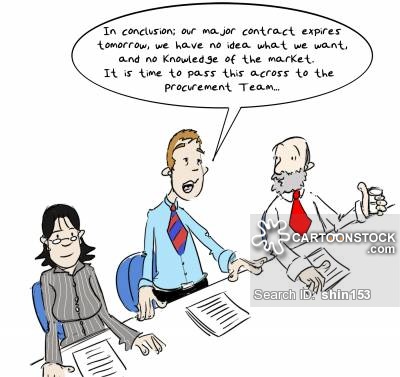
'In conclusion; our major contract expires tomorrow, we have no idea what we want, and no knowledge of the market,  It is time to pass this across to the Procurement Team,,,'


Do you have a contract expiring soon? Or are you working from a contract that already expired months or years ago and have not done anything with it?

Now is the time to act, do not let your contract go on any further until you know for sure it is beneficial to your company.

How do you go about making that assurance? By doing a lot of research and homework first and foremost, and asking those who need the goods and services on the contract if there are any changes, modification, recommendations that they would like to see. Many times goods are purchased through the supplier you have always worked with…or why rock the boat when it has always worked great for your company in the past.

In either circumstance, it is great you have confidence in your supplier or their product; but are they offering you the best product, warranty, certifications, services, pricing, and even net terms?

By running a RFI to gather information from your supplier’s competition, you can determine who’s who in the category. By running a RFP you can see if they can implement the same, or better pricing, or net terms.  Running a RFQ with all the suppliers, including your supplier or incumbent, you can be sure they are competitive in their pricing, terms, and goods.

It is never good business practice to let a contract expire or work from an expired contract. SafeSourcing can assist you in exploring your procurement solutions for your business or on our “Risk Free” trial program, please contact a SafeSourcing Customer Service Representative.  We have an entire customer services team waiting to assist you today.

We look forward to your comments

What can you do to save energy and money?

June 24th, 2015

There are many things that you can do around your house to save energy and money.


Today’s post is by Troy Lowe; Vice President of Development at SafeSourcing.

Everyone likes to save money.  There are many things that you can do around your house to save energy and money.  Some of the improvements can be costly such as replacing appliances with Energy Star appliances.  There are also many inexpensive things that can be done by you in your spare time.  With the improving technology there are some cool gadgets that can be installed to help.  For instance, installing a smart thermostat that learns your behavior and creates schedules for heating and cooling.  They also make devices that help reduce water consumption in your shower.  These devices work by decreasing the flow of water when the water reaches a certain temperature and when you are ready to shower, the flow of water will increase.  Some of these devices are also Wi-Fi enabled and record usage and water consumption.  This data can be viewed with an app that you install on your smart phone.

Below are some other things that can be done as well.

• Install compact fluorescent and LED light bulbs
• Caulk and Weather strip around doors and windows
• Install ceiling fans to help circulate the air and lower air conditioning use
• Install low-flow toilets
• Fix dripping faucets
• Replace furnace filters regularly
• Add additional attic insulation

If you would like some help researching some of these products, we can gather all the necessary information for you and help you decide which solutions meet your needs.  If you would like more information on how SafeSourcing can help you, please contact a SafeSourcing Customer Service representative.  We have an entire team ready to assist you today.

We look forward to your comments.

When is it time to change vendors?

June 23rd, 2015

And what is the best way to go about it?


Today’s post is by Tyler Walther; Account Manager at SafeSourcing.

When the right time to change vendors and what is the best way to go about it? Those are essential questions that take on strategic significance and can have serious implications. Maybe you’ve gradually become disgruntled with the quality of service provided by one of your current vendors. If you have determined you need a change, you should review the metrics you are using to assess vendors to see if all the standards for quality of services, provisioning of resources, and responsiveness are outlined in detail.

In reality, if there is a problem that your current vendor hasn’t resolved, the metric that addresses this performance standard will most likely be foremost in your mind. You may take that undesired experience and allow that to impact your view of what your expectations for the next vendor should be. You need to look carefully at all the metrics for success you have in place to see if one or more of your expectations wasn’t detailed clearly enough or defined in an assessable way.

There should always be an open line of communication with any vendor who wants to do business with you long term. Talk with the new potential vendor about what you’re looking for. Get their feedback on what’s achievable, practical, and realistic for the budget that will be allocated.

We enjoy bringing this blog to you every week and hope you find value in it.   For more information on how we can help you with your procurement needs or on our “Risk Free” trial program, please contact a SafeSourcing Customer Service Representative. We have an entire customer services team waiting to assist you today.

We look forward to your comments.