Customer Feedback: When and How to Use it

May 9th, 2014

Are you listening to your customers when they tell you what they want and if so how do you use it?


Today?s post is?from our?SafeSourcing?archives

Earlier this week a LinkedIn Post by Gregory Ciotti talked about how Steve Jobs didn?t listen to his customers.? The basis of the statement about Steve Jobs focused on creative and innovative approaches to new ideas that go beyond trying to deliver what customers wanted and onto figuring out what they wanted before they know it.? It wasn?t that Steve Jobs didn?t listen to his customers, he was just focused on the type of feedback we used from them.? Using this approach, Apple and dozens of cutting edge companies like them were able to continue delivering fresh and ground-breaking products to the market that customers couldn?t have talked about wanting in a feedback survey because they had no idea that something was even possible.? They only knew they liked it when they saw it.

Being able to develop new products in a vacuum may work for some companies like Apple, but the majority of companies can?t afford to ignore their customers? ideas and have customer bases that would resent even trying this approach.? That is why finding out what customers (both internal and external) want without directly asking them and then using that feedback to determine where the problems are without relying on them to tell how to resolve those issues is the key to effectively using customer feedback.

Discovering without asking ? The process of uncovering feedback without it being direct is key to getting effective information to improve procurement department?s processes.? When questions are asked that uncover how the customer felt during the process and what worked for them and did not work for them the basis of what the true issues are is developed without asking the customers to begin solving the problems.? Knowing that they were confused with where the priorities of the project fell is the beginning of understanding the issue.? Once the issue is know the procurement team can begin finding the solution to resolve it.

Seeking the issues not the solutions ? This piece goes hand in hand with the point above.? Focus on the details of what didn?t work not on the how to resolve them.? The danger with asking opened ended questions such as ?Did the process work for you??? or ?What can we do differently for you?? is that it instantly puts customers in a mode of trying to deliver a solution to you because their answers will usually be, ?Fix this.? Change this. If only it did this.?? These do not tell what the real issues are the way questions like ?How did you feel when we finished the pre-event kickoff call?? or ?What piece of information on the reporting was the most helpful?? Most confusing?? or even ?Did you understand the RFP result package to the point of having clear next steps???? Answers to these questions can then help the procurement team adjust the things to produce better results.

Prioritize the issues ? As with any process like this, not everyone will be satisfied and not every issue can be resolved immediately.? Coming up with a prioritized approach of dealing with the issues uncovered from customer feedback based on severity and frequency will allow the team to focus their attention on the areas that can make the most impact and show the greatest attention to the customer?s input.

For more information on how we can help you collect and use feedback from your internal and external customers to develop stronger sourcing processes and projects or on our ?Risk Free? trial program, please contact a SafeSourcing Customer Service Representative.? We have an entire customer services team waiting to assist you today.

We look forward to your comments.

What e-procurement KPI’s are on your dashboard?

May 9th, 2014

There are all types of dashboard promises out there. Is the data really useful?

Todays post is by Ron Southard CEO at SafeSourcing Inc.

At a minimum the following data fields; start date, event date, award date, letter of intent date, contract date, initial delivery date, total low company quotes, total all low quotes, award of business quotes are the basis for e-procurement KPI’s that will help to measure how your procurement department is performing and progressing over time and where opportunity for additional savings exist.

Wit the above data you can measure the following daily by department and associate assigned to that project. You should be able to actually click on any of the KPI’s to drill down for further analysis and causal data.

1. Opportunity lost cost results
2. Timeline analysis of a project launch to event, letter of intent and contract
3. Low quote company versus all low quotes or missed savings
4. Average days to complete event
5. Average days to complete award
6. Average days to complete LOI
7. Analysis of supplier count and line tem count versus where savings were maximized.
8. Number of events occurring above and below average.
9. Average or mean performance by KPI
10. Deviation or the best and worst events by KPI

If you had these KPI’s on your desktop of mobile dashboard, how much easier would it be for you to manage your business? If you don’t have this data please contact a SafeSourcing Customer Services Account Manager to find out just how easy it is to retrieve.

We look forward to and appreciate your comments.

YOU CAN HAVE YOUR CAKE AND EAT IT TOO!

May 8th, 2014

Happy 6th Birthday to SafeSourcing Inc.

Todays post is by Ron Southard, CEO at SafeSourcing Inc.

Wow does time fly when you are having a blast.

It seems like only  yesterday  that we launched  SafeSourcing on May 8th of 2008, but I guess it wasn’t. As such, we are both older and more experienced. That makes us better and that benefits our customers.

In 2014 we are doing business globally with a full procure to pay suite of applications that are multi-lingual and offered in a CLOUD based SaaS format. Our name is easily recognizable by the worlds largest companies.

To all of our customers, suppliers, associates, board of directors and other stakeholders past and present we offer our sincere THANKS and promise to offer even better quality and growth rates in the future. Without all of you we wouldn’t  be here .

HAPPY BIRTHDAY!

birthday_cake 

If you’d like to learn more about how SafeSourcing can assist you in reducing costs and improving earnings, please contact a SafeSourcing Customer Services Account Manager.

We look forward to and appreciate your comments,

Are you watching the commodity markets? Should you be?

May 7th, 2014

The answer is yes, and if you are not watching the correct Indices, you could be making some huge mistakes in your sourcing strategies.

Todays post is by Ron Southard, CEO of SafeSourcing Inc.

A customer asked me the other day what indexes we followed in our sourcing practices. Although this is a very broad question that could be answered any number of ways such as what product are you speaking about, it is in fact a very good question. Let me give you an example.

Let’s suppose you are planning your strategy to buy egg products such as whole eggs or liquid eggs or egg mixes. The first question you need to resolve is what makes up the largest cost in the egg farming process? To provide a short answer, it is feed. The follow on question to this should be; what type of grain makes up the feed? Again a short answer is corn. Resultantly these two questions should lead to the conclusion that keeping track of grain market futures is probably the best bet for locking in your pricing strategy depending on the length of your contract. As an example, with this information you might insert escalator and or  de-escalator language in your  terms and conditions request and resultantly in your contract based on the market price of  a specific crop at the time you negotiated your pricing.

The next step is determining where you can find this type of information. At SafeSourcing we use the CME Group  CME is the world’s leading and most diverse derivatives marketplace.  Relative to the egg market there is also another tool available that can be useful which looks at the average weekly price of egg products by region of the country. Using the two together is normally your best bet to build a solid sourcing strategy.

If you are not watching the markets that drive the pricing of the products you buy, you may make some significant mistakes that could negatively impact your financial plan down the road.

If you’d like to learn more about how SafeSourcing can assist you to determine how to best uncover the hidden costs that make up your products, please contact a Safesourcing Customer Services Account Manager.

We look forward to and appreciate your comments.

Ron Southard

Lean business practices create a weighty issue.

May 6th, 2014

The issue is what is so different today than yesterday and why do we even need this term in the procurement space?

Todays post is from Ronald D. Southard, CEO of SafeSourcing Inc.

This author tires of the desire of businesses that are trying to reinvent themselves and in so doing constantly coming up with new buzz words, industry terms and business jargon in order to try and prove that they are thinking differently and as such should be trusted to be on the right path. Maybe their original business plan was just flawed and they are not deserving of our trust.

Lean in any functional area of a business simply means producing more or getting more done with fewer resources. I’m not sure this is a great message for companies that are just launching, trying to grow or improve. If you’ve been around for while, and your customer reads between the lines properly, this may just mean that you did not plan your launch properly or react properly to market indicators in the past.

We all know that lean practices were originally a move to reduce costs in the manufacturing process and since it worked for manufacturing where we are typically talking about thousands if not millions of pieces and parts, other companies began to think why not for our business. As such let’s apply the term lean to the supply chain or the procurement space. Any one that knows the procurement space already understands the lack of resources.

The goal of every business should be to provide the end user or customer with what they want or what you have promised them at a fair price. If you do so, that customer and others that hear about that customers experience should buy more. When this happens, if the business plans appropriately they should grow and grow profitably. And this should create new and sustainable jobs. So, how is this any different than the way businesses were run 50 years go or even 100 years ago? The truth is that it’s not.

The decision to not hire, to try and do more with less and to reposition resources rather than firing someone is a better way to run a business. Unfortunately they do not teach this in business school. This author has been through many mergers, acquisitions, downsizings and the like over a lengthy career. One thing you can always count on in these scenarios is let’s cut expenses. You can call it lean, but it’s not.

So, let’s not hide behind the term lean or other business jargon or buzz words.

If you’d like to learn more about how SafeSourcing can help you reduce costs without reducing headcount, please contact a SafsSourcing Customer Services Account Manager.

We look forward to and appreciate your comments.

So you want to source your products from China?

May 5th, 2014

Do you have any idea what you are getting yourself in to?

Today’s post is by Ron Southard, CEO at SafeSourcing Inc.

In a recent article in USA TODAY titled Report: Drywall sickness real by Elizabeth Weise, the subtitle was Chinese Product confirmed culprit.

This author posted on this subject five years ago with the following two posts.

  1.   On May 21st of 2009 I posted.  In Hamlet, Marcellus said “Something’s rotten in Denmark”
  2.   On May 22nd of 2009 I posted. What lessons can be learned from yesterday’s post where we posited that “Something may be rotten in drywall from China”?

In the article by Elizabeth Weise mentioned above she goes on to report  that  Chinese made drywall was installed in more than 20,000 homes mostly in the south since 2005 causing a variety of health related complaints. In fact there have been 5 settlements totaling more than $1B. It is not clear how much of the drywall has been replaced.

So, do you really want to source your products from China? Much larger companies that we will leave unnamed have done so in the past and ended up with the type of results listed above.  At the end of the day, if you have not sourced products off shore, you had better know what you are doing!  Do your research or reach out to a company like SafeSourcing for help!

If you’d like to learn more about how SafeSourcing can help you with your off shore sourcing, please contact a SafeSourcing Customer Services Account Manager.

We look forward to and appreciate your comments.

As procurement professionals, each and every one of us should accept personal responsibility for protecting the environment.

May 2nd, 2014

Companies can’t operate as though their actions have no impact on the environment and today a variety of data supports that those who focus may well benefit from their actions.

Todays post is by Ron Southard, CEO at SafeSourcing Inc.

I was rereading a survey conducted in 2008 by the Disney Family of eight thousand (8,000) adults. When asked who should enforce environmentally sound practices?  Forty percent of respondents indicated that it should be the government; thirty nine percent indicated that it should be individuals; thirteen percent indicated that it should be businesses and nine percent indicated that it should be the schools. That forty percent of individuals surveyed defaulted to this being a government responsibility is an issue or a cop out dependent on your own beliefs.

This author doesn’t believe that government can do it alone without guidance from the people. I don’t believe that businesses can do it alone without guidance from the government in the form of standards. I don’t believe that people can do it alone without taking it to the work place. And, unless we focus on it in the home and the workplace there is not much schools can do to enforce their environmental educational content. If parents don’t support it, children will not participate. In fact without all of us working together towards a common goal success is questionable.

At SafeSourcing there are many things that we are passionate about. However, three drive our daily thinking and actions.

1. Reducing the costs of goods and services for our customers.
2. Supporting the global community through the sourcing of safe goods and services.
3. Supporting the environment through eco friendly sourcing practices that we hold suppliers accountable to that provide those goods and services.

Through these beliefs, we try to pay it forward every day where the environment is concerned. Can you or your company boil your environmentally focused CSR initiatives down to three distinct points that can be measured? If you can, your customers will notice. Ours do.

If you’d like to learn more about how SafeSourcing  can help you reduce your operating costs and give back at the same time, please contact a SafeSourcing Customer Services Account Manager.

We look forward to and appreciate your comments.

The Curse of the Comfort Zone!

April 28th, 2014

Does your company?s comfort level affect the procurement projects you are able to get done?

Today?s post is by Mark Davis; Sr. Vice President and COO at SafeSourcing.

It never ceases to amaze me that as human beings we spend our entire lives searching for prizes, concepts, and goals only to achieve them and then find, much to our chagrin, what they promised only leads to new and sometimes bigger problems.? I believe that the concept of comfort is one of those sensitive areas whose very definition proves alluring and yet in practice can create problems for individuals and companies alike.

Let?s look at Merriam-Webster?s definition of comfort.?

?Comfort – a state or situation in which you are relaxed and do not have any physically unpleasant feelings caused by pain, heat, cold, etc.?

While this definition focuses more on the physical well being, I believe the definition of comfort stretches to the intellectual and emotional areas as well.? Let?s be honest though, reading this definition, who wouldn?t want comfort?? Taken to the next step, once achieved, who wouldn?t want to do whatever it took to stay in comfort, to keep in a ?state or situation in which you are relaxed??

Therein lies the trap of comfort because people begin to make decisions, overlook opportunities that involve risk, and shy from the ?new? because they are afraid of losing the security of? the comfort zone.? When this happens the enticing nature of the benefits of comfort will create much bigger problems than the person or company ever faced before they became comfortable.

Does this mean comfort is a bad thing?? Definitely, not; it can bring a much needed break from an otherwise chaotic world if you are lucky enough to find it even briefly.? What is dangerous is when comfort slips into complacency and the mind starts looking at the risks associated with an opportunity with fear and mistrust rather than excitement and optimism.? Companies need to continue to look for the opportunities that will help them grow and get to new heights.? They need to examine longstanding vendor relationships they have grown ?comfortable? with.? They need to investigate new technologies that could make them stronger.? They need to evaluate the mindsets they have when making decisions for the future to ensure they are not too entrenched in the ?comfort? zone.

The comfort zone is nice and can be hard to break free of, but by moving on from a brief stay in this zone and into unchartered territories, the benefits will lead to stronger employees and business relationships and provide a stronger long term environment for your company based on weighing each risk and opportunity instead of investing that time trying to figure out how to maintain the comfort of the status quo.

For more information on how SafeSourcing can assist you? to break out of the ?comfort zone? or on our ?Risk Free? trial program, please contact a SafeSourcing Customer Service Representative.? We have an entire customer services team waiting to assist you today.

We look forward to your comments.
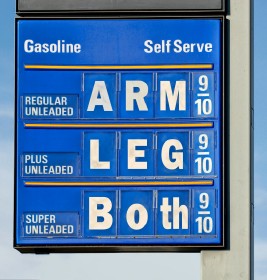
A Brief History Lesson in 9/10 of cent for Gasoline

April 25th, 2014

Why do gas prices always end in 9/10 of a cent?

Today?s post is written by Heather Powell, Manager of the COE Department & Project Manager at SafeSourcing Inc.

heather

?We have to go way back, approximately 1930, to when the oil companies were selling gas for, let?s say, 15 cents, and then the state and federal boards decided they wanted a piece of that to keep the roads going, so they added 3/10 of a cent. And the oil companies said, ?Well, we?re not going to eat that,? so they passed that on to the public.

Raising prices a penny would have been disastrous when gas only cost 15 cents. But why did it stick around?

They found out that if you priced your gas 1/10 of a cent below a break point, let?s say 40 cents a gallon, ‘.399’ just looked to the public like 39 cents?

You won’t find tenths of a cent on your credit card bill. Or even on the pump. But if you buy 15 gallons of gas at $3.299, you?re paying 13 cents more than at just $3.29. Since Americans buy 178 million gallons of gas a day, that?s a half-billion dollars more per year.

These types of details and hidden fees are what eat at the bottom line of companies. At SafeSourcing, Inc.? we find and bring out these levels of details for our customers when doing analysis for running Request for Proposals and Request for Quotes. For more information on how we can help you with your procurement needs or on our ?Risk Free? trial program, please contact a SafeSourcing Customer Service Representative.? We have an entire customer services team waiting to assist you today.

We look forward to your comments.

Who are we? Who are you?

April 24th, 2014

I started at SafeSourcing on February 17th 2014.

Today?s post is by Alyson Usserman, Account Manager at SafeSourcing.

I started at SafeSourcing on February 17th. I had interviewed multiple times, and came in ready to learn. Whenever anyone is hired on for a job, friends, family, and random people ask, ?What will you be doing?? Well, for some, that could be a potentially tricky question to answer. I found this question particularly cumbersome because, at the time, I knew what I would be doing, but I didn?t know. I didn?t know that this business is actually pretty tricky. For instance, when you say, ?live reverse auction,? people have one of two reactions. Either they have no idea what you?re talking about, or they absolutely hate them because of prejudgment or a bad prior experience.

While having a conversation last night with Arbonne?s CEO, Kay Napier, she asked me how I currently supported my family. I told her that I work for a procurement company in Dayton, Ohio. She seemed shocked while saying to me, ?I dislike things like that.? It?s a little daunting to have a CEO of a major company stand there and say that she dislikes your job. Talking with her more, I discovered that a past procurement company had promised more than they could provide in savings, a ?fool proof system? that didn?t work, and overall poor customer service. She too, told me that she was shocked after talking with me, and informed me that I was a great saleswoman.

Sometimes, people prejudge a process before actually knowing anything about it. In procurement that is one of the main obstacles I deal with every day. I will call a supplier to see if they have a particular product and then I am asked, ?What company is that, what do you do?? and they become focused on what we do when I am trying to ask questions of them, and their company.

SafeSourcing is a procurement party that is trying to help companies, not hinder them. For more information on how we can help you with your procurement needs or on our ?Risk Free? trial program, please contact a SafeSourcing Customer Service Representative.? We have an entire customer services team waiting to assist you today.

We look forward to your comments.