So you want to source from foreign countries?

March 24th, 2011

My first question might be why. And secondarily have you exhausted all local sources of supply for the products you wish to source?

The idea is that you hope this will allow you to compete with larger companies that have been sourcing lower cost products from these regions for years. So how can you catch up in a much shorter period of time?

If you’re dead set on moving forward and adding this strategy to your tool kit, the first and maybe most important step is to make sure you are working with a quality e-procurement solutions provider that should already have relationships in place with agents, 3PL’s and other companies that can manage much of this process for you and at a fraction of the cost of doing it yourself.

The National Customs Brokers and Forwarders Association of America www.ncbfaa.org can put you in touch with customs brokers and freight forwarders who can help you import your goods. Many of them offer informational websites that contain what is required in order to find the right customs broker or freight forwarder for your shipments. Your e-procurement solutions provider can also help you manage this process with third party logistics providers or 3PL’s in areas like ocean bound freight and national and local delivery and distribution that you may not have any experience in.

Companies can also visit the following website www.aapa-ports.org  (American Association of Port Authorities) for assistance with the technical aspects of the logistics industry including directories of custom brokers and freight forwarders.

This process is fraught with risk, but for growing companies that plan properly and use the right resources, there is profit to be made.

We appreciate and look forward to your comments.
Food Safety requires a community effort.

March 23rd, 2011

The team consists of more than just buyers, including farmers, processors, manufacturers, retailers, cooks, customers and anyone else in our global community that prepares, consumes or transports food products.

There is so much to food safety that I thought this time of year would be a great time to update everyone on the risk associated with food borne illness. During these holidays, we are exposed to so much more food than any other time of the year making it even more difficult than ever to trace outbreaks beyond historical one forward one back tracking.

So here goes, foodborne illness which can also be called food poisoning is any illness that results from eating contaminated food regardless of how it was contaminated. Harmful bacteria are the most common cause of food poisoning, but other causes include viruses, parasites, toxins and contaminants. The bacteria and viruses most frequently associated with food poisoning cases in the United States are Salmonella, Botulism, Norovirus,Vibrio Infections, Listeria, Hepatitis A, B.cereus, E.coli and Campylobacter.

A couple of great places to keep track of alerts and other up to date information is FoodSafety.gov  and USFOODSAFETY.COM. You can also visit the SafeSourcing wiki and our website www.safesourcing.com where alerts are covered from over a dozen organizations including other types of product safety. All of the above can be followed on Twitter.

 President Obama said it best “There are certain things only a government can do. And one of those things is ensuring that the foods we eat are safe and do not cause us harm.”

With a community of help we can all make the government’s job easier.

We look forward to and appreciate your comments.

Supply Chain Disruptions Come Without Warning

March 22nd, 2011

Today’s post is borrowed from Sourcing Innovation.

Most of my customers know that I recommend Sourcing Innovation very highly as a world class source of supply chain and sourcing information.

 The following post titled Supply Chain Disruptions Come Without Warning that focuses on the multitude of issues that can have an immediate impact on our supply chain. Enjoy.

Everyone is still talking about the recent Japan earthquake and the ramifications it will have on your supply chain for weeks, months, and years to come. No one is talking about the fact that, thanks to global warming, forest fire season is now upon as and that more than 30 wildfires raged through Oklahoma last weekend (Source) and that it only takes one fire to destroy a plant or distribution centre.

But it doesn’t take a natural disaster or a political uprising (such as the recent ones in Egypt and Libya) to instantly shut down your supply chain. A simple regulatory decision can have ripple effects through your supply chain. On March 10, the US Transport Security Administration (TSA) issued an emergency amendment to security measures that would take effect immediately that required freight forwarders with air cargo operations at non US locations to request additional information for all shipments on each master airwaybill (MAWB). As a result, Air Canada had to embargo all cargo flown to the US until further notice until they could be sure they were in compliance. (Source) Now, this embargo only lasted a day, but it could have lasted a week had the regulatory change been more onerous. But like a natural disaster, this disruption came without warning to shippers who relied on Air Canada to deliver their goods to the US.

That’s why you need contingency plans drawn up and ready to go, because you never know when you will need them.

We look forward to and appreciate your comments.

Going Green with eReceipt Technology!

March 21st, 2011

Today’s post is by Mark Davis; Vice President of Operations and CTO at SafeSourcing. Mark asks "What does the trend of moving to emerging eReceipt technology mean?"

There are two issues which constantly face the business world and the retailing world in particular; becoming more environmentally friendly and acquiring product that is tied directly to commodities such lead, oil, paper, etc.. 

One area that is tied to both of these issues and that has been getting a lot of recent attention is in the area of printed receipts.  Retailers spend millions of dollars a year on receipt paper and printers that produces a result that frequently ends up being thrown away.  This waste has developed into is a movement into the world of eReceipts; receipts that are emailed to the customer’s email account and that can be scanned at the store using the customer’s SmartPhone.

While this movement is just starting out, organizations like the National Retail Federation have predicted that as much as 60% of retailers will be paperless within 5 years.  So what does that mean for the procurement professional?

It means that for many of you, paper is not going to be gone tomorrow so keeping competitive contracts with current suppliers is still very important.  What it also means is that now may be the time as a company, to begin to explore the possibility of eReceipts and the huge savings it could represent to your company in paper, printers and ink, as well as the time spent making the paper receipts work.

One way to prepare for this move is to speak with your current partners and see what plans they have for this shift in retail operations.  Many POS, printer and paper companies have already seen this shift coming and have begun preparing the way with new products for this service.

You can also deal directly with 3rd party companies that specialize in this service.  If this is a move you anticipate making in the next 18-24 months it may be a good idea to think about conducting on RFI for this service with your IT and operations team.  RFIs that tie right into an online RFQ tool are a quick and easy way to get prepared for making a move into a new technology space that will not only encourage your company’s “green” initiatives but will likely save the company a great deal of money.

Feel free to reach out to a SafeSourcing account representative today to schedule a conversation about how to do this.

We look forward to and appreciate your comments.

When world events impact your sources of supply, what can you do?

March 18th, 2011

Here’s a twist! Continue to think globally but start to source more locally.

Many of you may be aware of the often used quote “Think Globally, Act Locally” which was reportedly coined by David Brower, founder of FOE or Friends of the Earth. Others have attributed it to Rene Dubos an advisor to the United Nations Conference of the Human Environment. Regardless of who said it, there are varieties of reasons to reconsider sourcing more of your products locally…

When oil prices hit their apex of over $150 per bbl, many companies began to consider sourcing more locally due to the increase in transportation costs. Some companies went as far as having their containers recycled and melted down because the cost of shipping them back to the Far East was just too expensive. What many do not realize is that carbon dioxide emissions from shipping are double those of aviation and increasing at an alarming rate which will have a serious impact on global warming according to research by the industry and European academics.
.
One international company’s study indicated that their carbon footprint came from four main areas. The second largest area was ocean freight at 23 percent. Additionally researchers at the Institute for Physics and Atmosphere in Wessling, Germany reveal that annual emissions from shipping range between 600 and 800m tonnes of carbon dioxide, or up to 5% of the global total. This is nearly double Britain’s total emissions and more than all African countries combined.

To be sure, most countries have signed and ratified the Kyoto Protocol which establishes legally binding commitments for the reduction of six greenhouse gases such as carbon dioxide, hydro fluorocarbons and others and are working with international companies to insure reductions. However, beyond the benefit of better pricing, the emissions issues associated with ocean freight shipping should provide additional incentive to North American based retailers to look within the NAFTA trade area for product alternatives to those sourced from areas that require ocean bound freight.

We look forward to and appreciate your comments.

Part II. A significant storm hit retail procurement years ago?

March 17th, 2011

What should we have done then and what should we be doing now?

As we discussed in yesterdays post, from a procurement perspective we have had a nor’easter circling for years. Companies have gone out of business that did not need to. So what can you do now that we are in the storm? Where is your information source?

There are a variety of ports to play on a word (portals), search engines and website home pages that may or may not contain what you are looking for in order to mitigate your risk to stormy conditions. The question you should be asking; is there one location that contains all or most of what I need and does not cost a nickel to access. If there were, it would need to include the following.

1. A central repository and launch point for industry alerts
2. A central source for procurement information
3. A central collaboration point for all procurement professionals to hold open forum conversations.
4. A central location where one can find specifications on thousands of products.
5. A central database of new global and local sources of supply
6. A central location that tracks suppliers environmental practices
7. A central location that tracks suppliers product safety practices
8. A daily educational commentary that can be reviewed and shared with others in the procurement space for mutual discussion and review.
9. A central location for your team to hold private forum conversations and share private documents.
10. A central location where companies can trace beyond one forward and one back if necessary after they have bought products or services.

During stormy times, the best offense is a good defense. When a storm approaches having the right tools to insulate you from the storm surge are critical. There is only one tool in the procurement space that can answer yes to providing all 10 points listed above.

SafeSourcing. If you don’t believe us ask our customers 

We look forward to and appreciate your comments.

A significant storm hit retail procurement years ago?

March 16th, 2011

And not all retail companies have weathered it well. I’m sure many of you can name some of them because they are not with us any longer. Others will follow!

The reason you are reading this paragraph at all is that bad news and weather sell. Bad news about the weather sells better. We see it at the grocery, convenience or drug store checkouts every time we make a purchase. How often do the news channels lead in with Good Samaritan stories? Everyone wants to follow the bad news. Men in particular like to follow news of bad weather. My wife says I can tell you the temperature and elevation at any time of the day as well of the impact of one on the other.

So what do you do in case of a storm? What is your information source?

From a procurement perspective we have had a nor’easter circling for years. And that is the worst kind of storm because it just keeps hitting you over and over again. This storm and it’s based on a lack of easily accessible information, we can be faced with any of the following on any given day.

1. Natural Disasters
2. The loss of a source of supply
3. Damaged goods
4. Product recalls
5. Product safety issues
6. Food borne illness issues
7. Environmental impact issues
8. Poor product specifications
9. Lack of adequate information when we need it
10. No way to openly collaborate with other procurement professionals
11. Transferred or promoted resources that leave a procurement brain drain

The question is how do you deal with this? There are a variety of portals, search engines and websites that may or may not contain what you are looking for.

What’s your answer? Where do you turn when it’s time to take shelter? Let’s hope it’s not just any port (al) in a storm.

Check back tomorrow and we’ll provide a preparedness kit for your use.

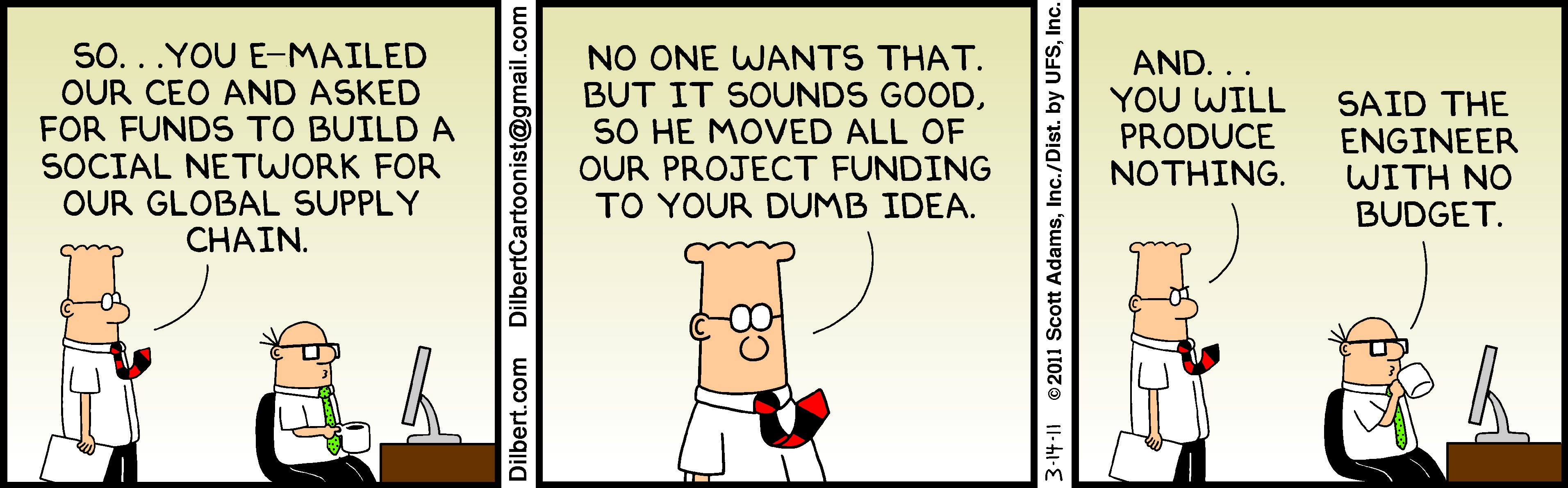
Social Media for the Supply Chain?

March 15th, 2011

Is Dilbert right? Please share your thoughts with us.

We don’t think so, because there already is one with a lot of members.

It’s called Sourcebook. Welcome to Sourcebook the procurement industries first professional social network. Enter your profile, choose an avatar, participate or lead threaded conversations with your peers.

We appreciate your comments.

Why does retail lag other industries in the percent of spend assigned to e-procurement tools.

March 11th, 2011

As I visit with retailers throughout North America, one theme continues to prevail. The percent of spend that retailers assign to the use of e-procurement tools lags that of all other industries. In fact in retail companies with sales of less than two billion dollars, the use of these tools is almost non existent.

I have heard everything from we don’t do things this way at our company to we’ve already attacked most of the low hanging fruit and our buyers are telling us there are no additional savings to be had from these categories.

I’m not trying to suggest that retail is adverse to driving change, or in fact being early adopters of technology. After all, retail was the original user of the cash register which evolved to electronic point of sale systems, sophisticated scanning systems and ultimately today’s self checkout systems. Retail has been a leader in the use of all types of technology driving advanced products such as electronic shelf labels and other RF technology. So why does there seem to be a reluctance to driving more spend with e-procurement tools.

I believe the answer lies in the tools themselves. E-procurement tools such as reverse auctions have a rich history of board room proof of concepts attended by CEO’s and CFO’s with astounding savings sometimes as high as 30% to 40%. This to the delight of the presenting vendor when the attending executive says we should be doing all of our buying this way.

As a result the retail company assigns resources and moves ahead with passion and vigor. Slowly however they seem to lose steam and both the number of events and the savings either stabilize or drop off.

The following issues lead to low utilization but are certainly not the only issues resulting in lack of transition to more spend being assigned.

1. Proper Executive sponsorship with resulting corporate policy changes are not in place and reviewed for compliance regularly.
2. Proper discovery of every category with all buyers is not conducted
3. Stores, offices and distribution centers are not walked and reviewed as part of the discovery process.
4. Products within categories are not weighted, calendarized and prioritized.
5. Tools are not easy enough to use so that retailers can host there own events after they run successfully the first time.
6. Vendors direct retailers to not run events that may have limited financial success.
7. Proper discussion is not held to review strategy like the use of and RFI versus an RFQ or how to use both successfully within the same category.
8. Pricing for an event that drove large savings the first time is the same the second and third time the event is run.
9. Due to the complexity of the tools, options for self service and assisted service are not available without staff increases if at all.
10. Databases with adequate sources of supply are not readily available to bring new suppliers and their resulting energy to events over an extended period.
11. An overall business plan is not developed with savings targets, percent of spend, reward systems and other milestones necessary to drive corporate wide utilization.

We look forward to  and appreciate your comments.

Sustainable success with your e-procurement program is not just based on financial results!

March 10th, 2011

Right or wrong, primary success in e-procurement programs is ultimately measured by cost reductions that drop directly to a company’s bottom line.

More than once I have heard; “did we hit a home run?” Unfortunately less emphasis is placed on cost avoidance and sustainability and as such can often lead to less spend be assigned to these very effective tools.

In order to ensure that e-procurement results are sustainable; the strategies for all targeted categories require a consistent deployment or Standard Operating Procedure (SOP) across all departments of the host company. This is accomplished by utilizing a well planned repeatable process for category selection and discovery, supplier research and selection, and a solid category strategy that is well understood by all buyers and category managers through negotiation and award of business.

After a quality specification is completed and terms and conditions agreed upon, supplier selection and management is the most critical stage and requires the understanding and participation of all sourcing professionals within an organization. One small mistake by anyone with the procurement organization could negatively impact the potential results of an e-procurement event whether and RFI, RFP or RFQ. Historical long term relationships that drive behind the scene comments like; “don’t worry we’ll be fine” to a long term supplier may drive inappropriate bid behavior and lack of ongoing credibility with your new e-procurement program, and may even have potential legal implications.

If you are not having the results you would like to or have less than twenty percent your total corporate spend assigned to e-procurement tools, it may be time to ask your provider why?

We look forward to and appreciate your comments